ITSM vs ITAM: Key Differences and When You Need Both in 2026
In 2026, IT teams are moving past siloed operations to embrace the convergence of IT Service Management (ITSM) and IT Asset Management (ITAM). While ITSM delivers services and ITAM governs the lifecycle of your hardware and software, integrating both is now essential for cost control, security compliance, and operational resilience. This guide explores why the most successful organizations are treating these two disciplines as a single, unified source of truth to drive strategic value and actionable intelligence.
On this page
- ITSM answers: How do we deliver, manage, and improve IT services? It governs incident management, service requests, change management, and SLAs.
- ITAM answers: What do we own, where is it, who has it, and what does it cost? It governs hardware inventory, software licensing, asset lifecycle, and disposal.
- They are not the same: ITSM focuses on service delivery processes. ITAM focuses on asset visibility and lifecycle control. Both are necessary; neither replaces the other.
- Where they intersect: Incident resolution (what device is affected?), change management (what assets does this change touch?), onboarding and offboarding (what needs to be provisioned or retrieved?), and compliance (what assets exist and are they tracked?).
- The integration problem: Running ITSM and ITAM as separate tools creates data gaps at every intersection point. Asset context requires a manual lookup. Change records do not update asset records. Disposal tickets and lifecycle records live in different systems.
- The solution: Unified platforms that run ITSM and ITAM on a shared data layer eliminate reconciliation overhead and produce better service delivery and compliance outcomes.
Introduction
An analyst opens an incident ticket. The employee has reported that their laptop is running slowly and several applications are crashing. The analyst needs to know which laptop the employee is using, what operating system version it runs, when it was last patched, what software is installed, whether the device is under warranty, and whether any changes were made to it recently. In most organizations, that information lives in a different system from the one the analyst is using to manage the ticket.
This scenario plays out thousands of times a day in IT departments around the world, and it illustrates the central problem with treating IT Service Management (ITSM) and IT Asset Management (ITAM) as separate disciplines managed by separate tools. They are distinct practices with distinct purposes, but they depend on each other's data constantly. When that data is siloed, both practices underperform. This guide explains what ITSM and ITAM are, how they differ, where they overlap, and how organizations can structure both disciplines to avoid the friction that siloed tools create.
What Each Discipline Does
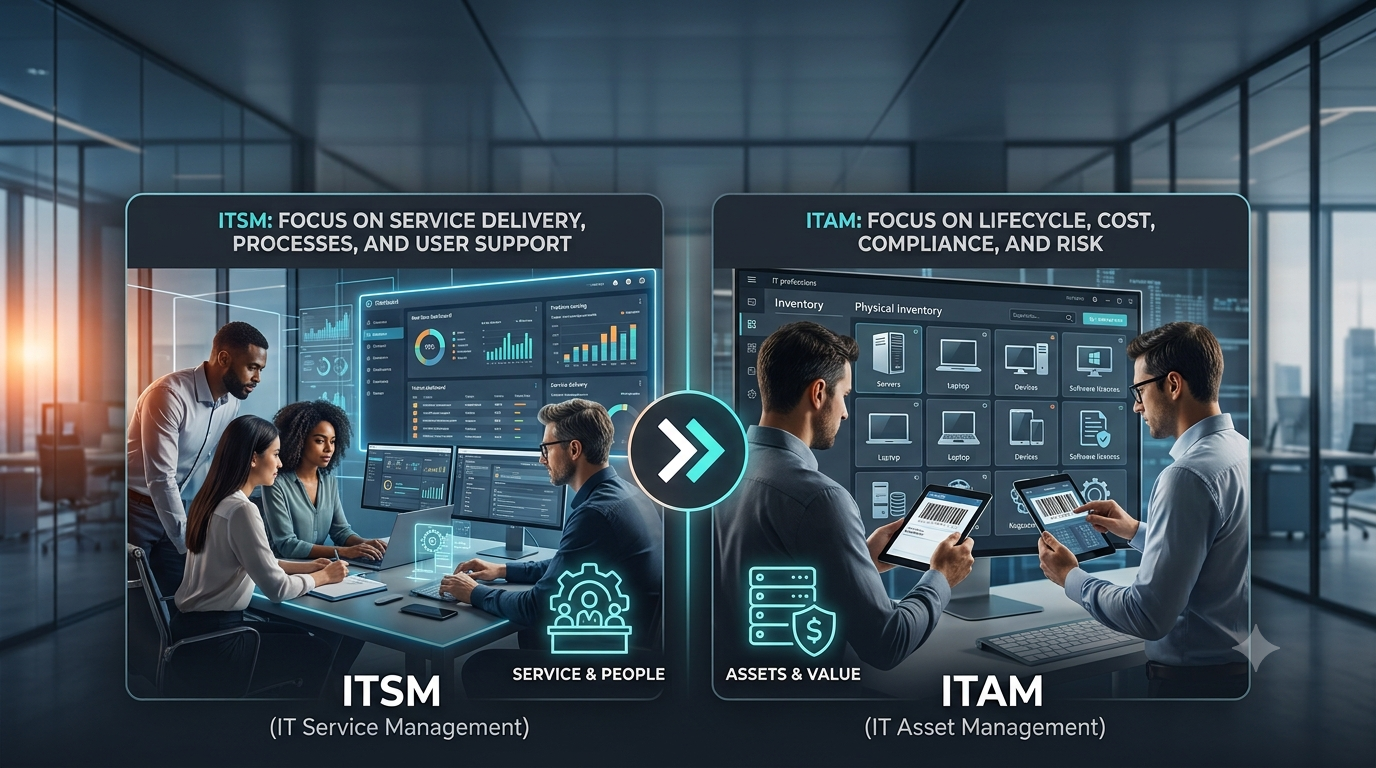
Focus: How services are delivered
- Incident management
- Problem management
- Change management
- Service request fulfillment
- Service level management
- Service catalog and portal
- SLA tracking and reporting
Focus: What assets exist and their state
- Hardware inventory and tracking
- Software license compliance
- Cloud resource management
- Asset lifecycle governance
- Financial depreciation tracking
- Disposal and data sanitization
- Cost allocation and optimization
The difference is most clearly stated as a question each discipline answers. ITSM answers: "How do we deliver, manage, and improve IT services?" ITAM answers: "What do we own, where is it, who has it, and what does it cost?" Both questions matter. Neither answer makes the other unnecessary.
Key Differences: A Direct Comparison
| Dimension | ITSM | ITAM |
|---|---|---|
| Primary question | How are services delivered and measured? | What assets exist, what do they cost, are they compliant? |
| Primary stakeholders | IT operations, service desk, end users | Finance, procurement, compliance, IT ops |
| Key data | Tickets, SLAs, incidents, changes, knowledge articles | Asset specs, license counts, costs, depreciation, warranties |
| Success metric | MTTR, first-contact resolution, SLA compliance | License compliance rate, asset utilization, TCO, cost savings |
| Update frequency | Continuously — every ticket interaction | Continuously for discovery; periodically for financial records |
| Compliance purpose | Access governance, change audit trails | License compliance, asset inventory, disposal documentation |
| ROI timeline | 6-12 months for measurable service improvement | 6-12 months for cost savings, faster for compliance readiness |
Where ITSM and ITAM Intersect
Despite their different purposes, ITSM and ITAM share critical operational touchpoints where the quality of one discipline directly affects the other. These intersections are exactly where siloed tools create the most friction.
Incident Resolution: The Asset Context Gap
When an incident ticket is created, the analyst immediately needs asset context: which device is affected, what OS version it runs, when it was last patched, and whether it is still under warranty. In a siloed environment, this requires a manual lookup in a separate ITAM system — a context switch that adds minutes to every ticket and creates risk that the analyst resolves the incident using asset data that is 24 hours stale because the sync has not run. In a unified platform, asset context surfaces automatically when the ticket opens, pulling from the live asset record rather than a synced copy.
Change Management: The Asset Impact Assessment
A change request should reference the assets it affects. A software update to a production database affects specific servers, which support specific services, which will experience specific impact during the change window. Without ITAM data connected to change management, change impact assessments are based on what analysts remember rather than what the asset inventory documents. Changes that should trigger a full CAB review get classified as standard because nobody queried the asset relationships. The result is unexpected service impacts from changes that appeared low-risk.
Onboarding and Offboarding: The Lifecycle Event
A new hire creates simultaneous ITSM and ITAM work: the ITSM side creates a service request for equipment and access provisioning; the ITAM side updates device assignment records, SaaS license provisioning, and cost allocation. In siloed systems, these happen in separate tools, often by different teams, with no automated connection between the HR event that triggered both and the records that document them. The full lifecycle governance framework is covered in Employee Onboarding and Offboarding: Complete Workflow Guide.
Compliance: The Evidence Assembly Problem
SOC 2, ISO 27001, and HIPAA auditors expect evidence that crosses both ITSM and ITAM domains: that access was provisioned based on authorized roles (ITSM), that the devices holding that access were tracked (ITAM), that access was revoked at termination (ITSM), that devices were wiped at disposal (ITAM). When this evidence lives in two systems, assembling it for an audit requires manually correlating records across both. When it lives in a unified platform, the evidence package is exportable in minutes. For the compliance documentation requirements this implies, see Asset Lifecycle Compliance: Meeting IT Standards in 2026.
Integration vs. Unified: The Architectural Choice
Most IT organizations address the ITSM-ITAM overlap by integrating separate tools via API. The integration passes asset data into service tickets and potentially syncs ticket status back into asset records. It works, most of the time, well enough that nobody questions whether "works most of the time" is an adequate standard for operational infrastructure.
API integrations introduce sync latency — asset data in the ITSM tool is always slightly behind the current state in the ITAM system. For fast-moving environments where device configurations, software installations, and user assignments change daily, 24-hour sync latency means analysts are regularly making decisions on outdated asset context. The integration also requires ongoing maintenance: schema changes in either tool break the integration until someone fixes it. And the integration never fully closes the data gap, because it can only sync what was explicitly mapped when it was configured — every new data field added to either system requires a new mapping update.
A unified platform eliminates these problems structurally rather than managing them operationally. ITSM and ITAM share the same database. Asset context in a ticket is not a synced copy — it is the live asset record. Changes to asset attributes appear in ticket context immediately. The compliance evidence that both disciplines generate is in the same system, exportable from the same interface. The argument for unified platforms over integrated separate tools is made in full in ITSM and ITAM Integration: Why Unified Platforms Win.
How WorkVerge Unifies ITSM and ITAM
WorkVerge was designed from the start as a unified platform rather than an ITSM tool with an ITAM integration. ITSM and ITAM share the same data model, the same record structure, and the same user interface — with no sync required because there is nothing to sync.
- Asset Context Native in Every Ticket: When an incident opens, the analyst sees the device's full ITAM record — configuration, warranty, compliance status, recent changes, cost data — without leaving the ticket or querying a separate system.
- Change Management with Real Asset Relationships: Change requests in WorkVerge reference the exact assets they affect, pulled from live ITAM data. Impact assessments are based on the current asset inventory, not on what was synced last night.
- Lifecycle Events That Update Both Simultaneously: When an employee is onboarded, the ITSM provisioning workflow and the ITAM device assignment update happen in the same transaction. When an employee is offboarded, the ITSM access revocation and the ITAM license reclamation are the same workflow, not two systems that need coordination.
- Single Compliance Evidence Package: SOC 2, ISO 27001, and HIPAA audit requests are answered with a single export covering both the service delivery records (ITSM) and the asset lifecycle records (ITAM) that auditors require.
Conclusion
ITSM and ITAM are distinct disciplines with distinct purposes, and organizations that treat them as interchangeable or as optional are consistently paying a cost they do not see directly. The cost appears as longer incident resolution times, change-induced service impacts, compliance audit findings, and budget waste from untracked assets and unreclaimed licenses.
Both disciplines are necessary. The architectural question is whether to run them as separate tools connected by an API or as a unified platform with a shared data layer. For organizations where the intersection points are frequent, compliance requirements are real, and operational efficiency matters, the case for unification over integration is compelling. The total cost comparison between the two approaches consistently favors unification when the full operational overhead of maintaining integrations is factored in alongside the license cost difference.
Ready to see ITSM and ITAM working from the same data layer? WorkVerge connects service delivery, asset management, and employee lifecycle in a single platform — no integrations required.
Start Your 30-Day Free TrialNo credit card required · Full premium access · Connect in under 10 minutes
Share this article