ITSM + ITAM Integration: Why Unified Platforms Win in 2026
Discover how uniting IT Service Management (ITSM) and IT Asset Management (ITAM) into a single platform eliminates operational silos, cuts software licensing costs, and accelerates incident resolution across your organization.
On this page
- The Integration Model Fails: API integrations between ITSM and ITAM tools create sync latency, require ongoing maintenance, and accumulate data reconciliation debt that grows with organizational complexity.
- Five Gap Points: The integration gaps show up most painfully at incident resolution, change management, onboarding and offboarding, compliance evidence assembly, and asset lifecycle automation.
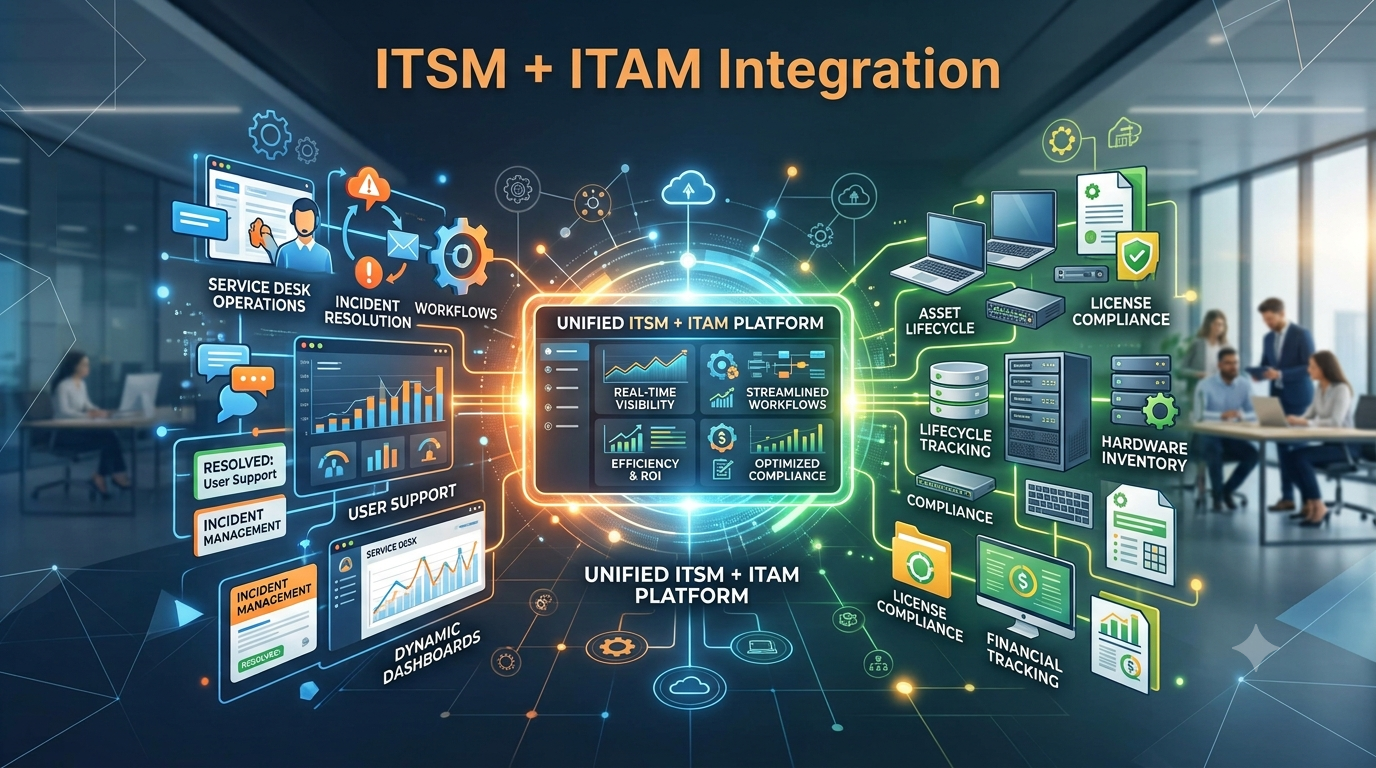
- What Unified Means: A unified platform is not two tools with a strong API. It is a single platform where ITSM and ITAM share the same data model, the same record, and the same user interface — with no sync required because there is nothing to sync.
- The ROI: Organizations that move from integrated separate tools to unified ITSM+ITAM platforms report 15-20% reduction in ITAM administration time, 25-40% faster incident resolution, and significantly reduced audit preparation overhead.
- When Integration Is Adequate: For organizations under 100 employees with low compliance requirements, a well-configured integration between best-of-breed tools is often sufficient. The case for unification strengthens with organizational complexity, compliance requirements, and team size.
- WorkVerge: WorkVerge's unified ITSM and ITAM platform was designed from the ground up with a shared data layer — meaning asset context is native to every service interaction, not injected via API at the moment of lookup.
Introduction
Most IT organizations run ITSM and ITAM as separate tools with an integration connecting them. The integration passes asset data into service tickets when an analyst opens them, and potentially syncs ticket status back into the asset record. It works, most of the time, well enough that nobody questions whether "works most of the time" is an acceptable standard for operational infrastructure that underlies incident resolution, change management, compliance evidence, and employee lifecycle management.
The questioning usually starts when something breaks. An analyst resolves an incident based on asset data that was 24 hours stale because the sync had not run. A change is approved and executed, but the asset records are not updated because the sync was not configured to handle configuration changes. An auditor asks for evidence that a specific device was wiped before disposal, and the certificate is in the ITAM system while the disposal ticket is in the ITSM system, and reconciling them takes two days of manual effort. These are integration failure modes, and they are not edge cases. They are the predictable consequences of treating two deeply interconnected disciplines as independent tools that happen to share some data.
This article makes the case for unified platforms over integrated separate tools, explains where the integration model fails in practice, and describes what unified platforms deliver that integration cannot. For organizations already using separate ITSM and ITAM tools and evaluating whether to migrate, this is the decision framework that determines whether integration maintenance or platform consolidation is the right path forward.
Where the Integration Model Fails
A well-configured API integration between ITSM and ITAM tools delivers real value. Asset records appear in incident tickets. Change requests reference the affected configuration items. The integration is not useless. But it has structural failure modes that become more costly as organizational complexity grows, compliance requirements tighten, and the volume of cross-system workflows increases.
API integrations run on schedules — typically hourly or daily. Between sync cycles, the data in the ITSM system reflects the state of assets as they were at the last sync, not as they are now. An analyst resolving an incident about a laptop that was reimaged this morning is looking at last night's configuration data. A change advisory board reviewing a change request is looking at asset states that may have changed since the last sync. In low-velocity environments with stable assets, this latency is tolerable. In environments with frequent cloud provisioning, regular device changes, or active software deployment, the latency means analysts and change managers are routinely working from outdated information.
The consequence is not just operational inconvenience. Decisions made on stale asset data, including security incident response decisions and change impact assessments, carry elevated risk that a shared data layer eliminates entirely.
Every API integration has a maintenance cost that is rarely budgeted at the point of implementation. When either platform releases an update that changes an API endpoint, response format, or authentication method, the integration breaks until it is fixed. The fix requires someone with integration expertise, access to both systems, and time that was not scheduled. According to Gartner ITAM research, organizations with point-to-point integrations between ITSM and ITAM tools report spending an average of 15-20% of their ITAM administration time on integration maintenance, data reconciliation, and gap remediation. That is time that could be spent on the visibility and cost optimization work that ITAM exists to deliver.
The highest-value workflows in IT operations span both ITSM and ITAM: onboarding provisioning that creates both a service ticket and an asset assignment, change management that updates asset records when changes are executed, offboarding that closes service access and triggers asset recovery simultaneously. These cross-system workflows cannot be configured in either ITSM or ITAM tool alone. They require custom integration development, middleware configuration, or workflow orchestration tools that add complexity, cost, and additional maintenance burden. Organizations that want automated cross-system workflows in an integrated environment are essentially building a lightweight unified platform on top of their integration, which raises the question of why they are not using a unified platform to begin with.
Compliance frameworks including SOC 2 and ISO 27001 require evidence that spans both service management and asset management: that access was granted through a controlled process (ITSM), that the device receiving access was tracked in the asset inventory (ITAM), that changes were approved before execution (ITSM), and that those changes updated the asset configuration record (ITAM). When ITSM and ITAM are separate tools, producing this combined evidence requires manually pulling records from both systems and reconciling them for each audit request. In integrated environments, this reconciliation is the most common source of audit preparation delays and findings. In unified environments, the evidence is assembled from one system because there is only one system.
When ITSM and ITAM tools contain conflicting data about the same asset, both systems become unreliable. The ITSM system says the device assigned to an employee is a MacBook Pro. The ITAM system says it is a MacBook Air. One of them is wrong, but neither system can determine which, because both received their data from different sources at different times. Over time, data conflicts accumulate until neither system is trusted as authoritative, which defeats the purpose of maintaining either. In integrated environments, data conflicts are an expected maintenance problem. In unified environments, data conflicts between ITSM and ITAM do not exist because there is a single record that both views read from.
What Unified Platforms Deliver That Integration Cannot
A unified ITSM and ITAM platform is not two tools with a stronger integration. It is a single platform where both disciplines share the same underlying data model, meaning every service interaction and every asset record read from the same source of truth without any data movement between systems.
When an analyst opens a ticket in a unified platform, the affected user's full asset profile is part of the ticket view — not fetched via API at the moment of opening, but native to the ticket record. The device model, OS version, patch status, warranty state, recent configuration changes, and software inventory are available instantly, without a lookup, without API latency, and without the risk that the data is stale. Analysts work faster and make better decisions because they have complete context from the moment the ticket opens. Studies on analyst productivity in unified versus integrated environments consistently find 25-40% reductions in mean time to resolution, driven primarily by the elimination of the information-gathering steps that precede diagnosis in integrated environments.
In a unified platform, a change record and the asset records it affects are part of the same data model. When a change is approved and executed, the affected asset records update automatically as part of the change closure workflow. There is no separate ITAM sync required. There is no risk that the change execution updated the device but the integration did not propagate the change to the ITAM record. Configuration drift caused by changes that update ITSM but not ITAM does not occur because both are the same system.
Onboarding a new employee in a unified platform triggers a single workflow that creates both the provisioning tickets (ITSM) and the asset assignment records (ITAM) simultaneously, without middleware and without custom development. Offboarding triggers access revocation (ITSM) and asset recovery (ITAM) in the same workflow, producing a unified audit trail that covers both sides of the transaction. These are native workflow capabilities of a unified platform. They are custom development projects in an integrated environment.
In a unified platform, the compliance evidence that spans service management and asset management comes from one record. The SOC 2 auditor asking for evidence that a change was approved and that the affected asset records were updated receives a single report. The ISO 27001 auditor asking for evidence that access was granted through a controlled process and that the device was in the tracked asset inventory receives a single report. Audit preparation that takes days in an integrated environment takes hours in a unified one, because the reconciliation step simply does not exist.
| Operational Scenario | Integrated Tools | Unified Platform |
|---|---|---|
| Asset context in incident tickets | API fetch at ticket open (latency risk) | Native to ticket record (real-time) |
| Change execution updating asset records | Requires separate sync or manual update | Automatic on change closure |
| Onboarding workflow | Two separate processes needing coordination | Single workflow spanning both disciplines |
| Offboarding workflow | IT and asset recovery managed separately | Single workflow with unified audit trail |
| Compliance evidence assembly | Manual reconciliation across two systems | Single system, single export |
| Data conflict resolution | Ongoing maintenance requirement | Not applicable — single source of truth |
| Integration maintenance | 15-20% of ITAM admin time (Gartner) | Zero — no integration to maintain |
These comparisons assume a well-configured, actively maintained integration between separate tools. The gap widens with poor integration configuration, infrequent maintenance, or high change velocity environments.
When Integration Is Adequate and When It Is Not
The case for unified platforms is strongest when organizational complexity, compliance requirements, and cross-system workflow volume are high. For smaller organizations with simpler requirements, a well-configured integration between purpose-built tools may deliver more value than a unified platform, because the best-of-breed tools in each category may offer deeper specialist functionality than a unified platform's integrated modules.
Integration Is Adequate When...
Your organization is under 150 employees, your compliance requirements are limited to basic audit readiness rather than formal certification, your change management volume is low, and your ITSM and ITAM tools were chosen for specific capabilities that no unified platform currently matches. At this scale and complexity, the integration maintenance overhead is manageable and the reconciliation work is limited enough to be worthwhile for the specialist functionality each tool provides. The threshold shifts as the organization grows: at 300+ employees with active SOC 2 or ISO 27001 requirements, the integration maintenance overhead and compliance reconciliation cost typically exceed the specialist functionality value of separate tools.
Unified Platform Is the Right Choice When...
Your organization runs more than 200 employees with an active compliance program, you process more than 500 IT service tickets per month, your change management process involves cross-system asset tracking, you are experiencing data conflicts between ITSM and ITAM records, your integration maintenance is consuming meaningful IT administration time, or your audit preparation requires days of manual reconciliation. Each of these conditions individually justifies evaluating unified platforms. In combination, they make the unified platform the clearly superior operational model. The evidence from organizations that have made the transition is consistent: the reconciliation overhead reduction alone typically justifies the migration cost within 12-18 months.
How WorkVerge Delivers Native ITSM and ITAM Unification
WorkVerge was designed from the ground up with ITSM and ITAM on a shared data model — not two products integrated after the fact, but two disciplines built into a single platform from the initial architecture decision. The difference this makes is not superficial. It is structural, and it shows up in every scenario where ITSM and ITAM data need to be used together.
- Asset-native incident management: Every incident ticket in WorkVerge carries the full asset profile of the affected user's devices as part of the ticket record — model, OS, configuration, patch status, recent changes, warranty state. This data is not fetched via API when the ticket opens. It is part of the ticket data model. Analysts have complete context from the moment of assignment, and the context is always current because there is no sync cycle to fall behind.
- Change management that writes to asset records: WorkVerge's change management module is built to update asset configuration records as part of the change closure workflow. A change that modifies a device configuration automatically updates the ITAM record for that device. A change that decommissions a server automatically initiates the asset retirement workflow. The feedback loop between service management events and asset state is continuous and automatic, not dependent on integration sync or manual update.
- Unified onboarding and offboarding workflows: WorkVerge's employee lifecycle workflows span ITSM and ITAM natively. A new hire workflow creates provisioning tickets, assigns the device from inventory with a digital chain-of-custody record, provisions system access, and logs the complete transaction in a single audit trail. An offboarding workflow revokes access, initiates asset recovery, verifies data wipe, and closes the lifecycle record — all in one workflow, not two processes that need to be manually correlated for compliance purposes.
- Compliance evidence from one source: Because WorkVerge holds ITSM and ITAM data in the same system, compliance evidence spanning both disciplines is generated from a single export. SOC 2, ISO 27001, HIPAA, and GDPR audit requests that would require multi-system reconciliation in an integrated environment are answered with a single report in WorkVerge. Audit preparation that takes days becomes a matter of hours.
- No integration to maintain: WorkVerge eliminates the integration maintenance overhead that consumes 15-20% of ITAM administration time in integrated environments. There are no sync schedules to monitor, no API version updates to chase, no data conflict resolution processes to run. The administrative capacity freed by eliminating integration maintenance is redirected to the strategic ITAM and ITSM work that actually improves IT performance and reduces costs.
For organizations evaluating the full landscape of ITSM platforms before making a unification decision, Best ITSM Tools in 2026 covers the leading platforms and their ITAM integration depth. For the foundational understanding of how ITSM and ITAM relate to each other, ITSM vs ITAM: Key Differences and When You Need Both provides the framework.
Conclusion: Integration Is a Workaround, Unification Is the Solution
API integration between ITSM and ITAM tools is a pragmatic solution to a structural problem: two disciplines that need to share data but were built on separate platforms. It works well enough at low organizational complexity, and it fails progressively as complexity grows. The failure modes, sync latency, integration maintenance overhead, data conflicts, and compliance reconciliation burden, are predictable and well-documented. They are also all eliminated by design in a unified platform.
The decision between integration and unification is not primarily a technology decision. It is an operational decision about acceptable overhead. Organizations that can sustain the integration maintenance cost, tolerate the sync latency, and absorb the compliance reconciliation work indefinitely have a rational case for staying with integrated separate tools. Organizations that cannot, or prefer to redirect that overhead to higher-value work, have a rational case for unified platforms.
The trajectory of the market reflects this logic. The fastest-growing segment of the IT operations platform market in 2026 is unified ITSM and ITAM platforms, driven by organizations that have quantified the true cost of their integration overhead and concluded that the consolidation investment pays back within 12-18 months. The integration model served the market well for a decade. Unified platforms are what the market is moving toward.
Share this article