Blog
Best ITSM Tools in 2026: Top Platforms Ranked and Compared
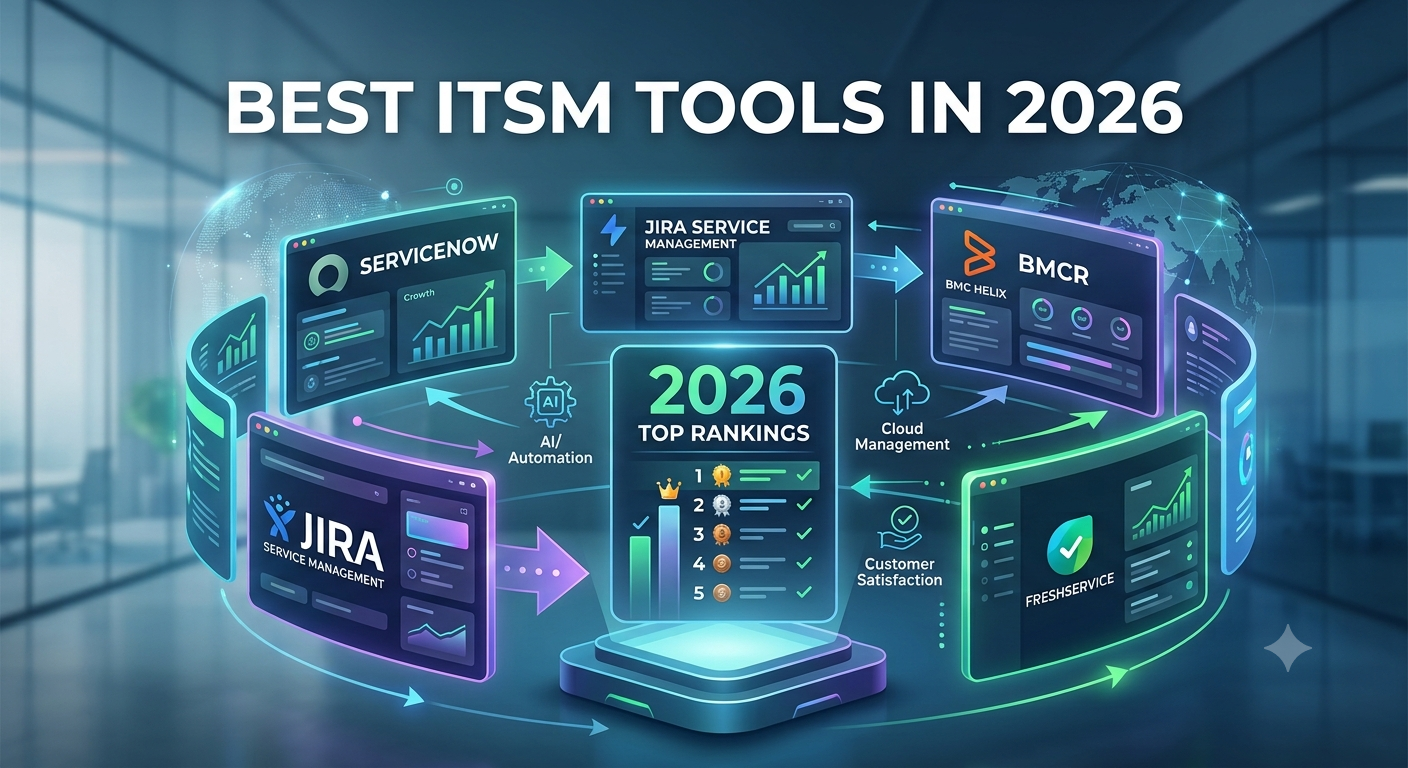
Finding the right IT Service Management platform shouldn't feel like guesswork. Whether you need an enterprise heavyweight like ServiceNow, a DevOps-friendly option like Jira, or an agile mid-market solution, we have ranked and compared the best ITSM tools of 2026 to help you find the perfect match.
On this page
TL;DR
ServiceNow: The enterprise standard. Unmatched depth and configurability, but only justified for 500+ employee organizations with a dedicated admin team and $100K–$500K+ implementation budget. Starts ~$100+/agent/month.
Jira Service Management: Best for DevOps-driven IT teams already in the Atlassian ecosystem. Transparent pricing ($20–$51/agent/month), fast setup, tight dev-ops alignment. Less intuitive for non-technical IT staff.
Freshservice: Best time-to-value for mid-market. Fastest deployment (days to two weeks), clean UX, solid ITIL alignment. Starts at $19/agent/month. Workflow complexity hits limits at enterprise scale.
ManageEngine ServiceDesk Plus: Best budget option with real ITIL coverage. On-premise or cloud, starting around $10/technician/month. UI is dated but feature breadth is strong for the price point.
DevRev: AI service desk agent for IT and HR requests, with asset data integrations through Intune, Jamf, and SysAid. Price: Free Mini plan; consumption-based credits (Agent Studio available from Pro). Best for: IT and HR teams adding an AI service desk agent to their existing tools.
The Rule: Do not buy ServiceNow until you have genuinely outgrown simpler tools. 80% of organizations get 80% of the value from a mid-market platform at a fraction of the cost and complexity.
Introduction
Every IT leader evaluating ITSM tools in 2026 is navigating the same tension: platforms powerful enough to handle enterprise complexity are expensive to license, slow to deploy, and expensive to maintain. Platforms fast enough to deploy in a week tend to hit capability ceilings the moment workflows get complicated. The market has not converged on a single answer — it has diverged into segments, each with a different resolution to that trade-off.
This guide takes an honest approach to the comparison. Rather than ranking platforms on raw feature counts, it evaluates them on the criteria that determine whether an ITSM program actually succeeds: fit by organization size and maturity, realistic deployment timeline, total cost of ownership, ITAM integration depth, and the user experience that drives adoption. Pricing data is based on publicly available information as of August 2026 and should be validated against current vendor quotes. For the foundational context on what ITSM is and what each core process covers, see What is ITSM? Complete Guide to IT Service Management in 2026.
Quick Comparison: ITSM Platforms at a Glance
Platform | Best For | Starting Price | Deploy Time | ITAM Built-in |
|---|---|---|---|---|
ServiceNow | Large enterprises (500+ staff) | ~$100+/agent/mo | 3–9 months | Yes |
Jira Service Management | DevOps-driven IT teams | Free / $20/agent/mo | 4–8 weeks | Partial |
Freshservice | Mid-market, fast time-to-value | $19/agent/mo | Days to 2 weeks | Yes |
ManageEngine ServiceDesk Plus | Budget-conscious, on-prem option | ~$10/tech/mo | 2–4 weeks | Yes |
DevRev | AI resolution for IT and HR requests | Free Mini plan; consumption-based credits | Weeks | Asset data through Intune, Jamf, and SysAid connectors |
WorkVerge | Unified ITSM + ITAM + EXM | Contact sales | 2–4 weeks | Native |
Pricing as of August 2026 based on publicly available data. ServiceNow pricing reflects industry-reported estimates from TechnologyMatch and InvGate. Verify all figures against current vendor quotes before making a purchasing decision.
Platform Reviews
1
The Enterprise Standard
Price: ~$100+/agent/month Deploy: 3–9 months Best for: Enterprises 500+ employees
ServiceNow is the recognized market leader in enterprise ITSM and the only platform named a Leader in Gartner's 2025 AI ITSM Magic Quadrant. Its depth is genuine: full ITIL process coverage, a mature CMDB, sophisticated workflow automation, a sprawling integration marketplace, and enterprise-grade reporting that no other platform in this comparison matches. For large organizations with complex multi-department service delivery requirements, dedicated admin resources, and the budget to match, ServiceNow is the right choice.
The trade-off is substantial. ServiceNow is designed to be configured, not deployed out of the box. A standard implementation runs 8–12 weeks for basic modules. Complex, multi-department deployments routinely run 6–12 months and require certified ServiceNow consultants, typically adding $100,000–$500,000+ in professional services on top of licensing. Organizations that over-customize in year one frequently find that upgrade cycles become blocked by their own prior configurations. Do not buy ServiceNow until you have genuinely outgrown simpler tools — the vast majority of mid-market organizations have not.
2
Best for DevOps-Driven Teams
Price: Free / $20–$51/agent/month Deploy: 4–8 weeks Best for: Atlassian ecosystem, dev-adjacent IT
Jira Service Management (JSM) is Atlassian's ITSM platform, and its defining strength is depth of integration with the Atlassian ecosystem. Organizations already running Jira Software for development workflows, Confluence for documentation, and Bitbucket for source control gain significant value from keeping IT service management inside the same platform. Incidents can be linked directly to the Jira Software issues that caused them. Change requests can reference the exact deployment that triggered them. Pricing is transparent and competitive: free for up to 3 agents, Standard at $20/agent/month, Premium at $51/agent/month.
The limitation is cultural fit. JSM's interface is built for teams that think in queues, sprints, and issue trackers. IT generalists who are not development-adjacent often find it less intuitive than Freshservice. Change management depth is also lighter than ServiceNow for complex multi-department CAB processes. Marketplace apps that fill these gaps add cost that erodes the pricing advantage at scale.
3
Best Time-to-Value for Mid-Market
Price: $19–$109/agent/month Deploy: Days to 2 weeks Best for: Mid-market (50–500 employees)
Freshservice occupies the middle ground that ServiceNow is too heavy for and a pure helpdesk tool too light for. It covers the full ITIL process set with a clean, low-training-overhead interface that IT managers and non-technical staff alike find straightforward. Deployment timelines are measured in days to two weeks for a standard configuration — no implementation partner required for most mid-market deployments. For organizations that need structured ITSM workflows without enterprise-grade cost or complexity, Freshservice delivers the fastest path from decision to production. Native asset management with discovery is included, making it a strong all-in-one option for teams that do not need deep ITAM customization.
The ceiling becomes visible when workflow complexity grows beyond standard ITIL processes. Enterprises that push Freshservice into complex multi-tier automation frequently encounter limits in the automation engine. Per-asset discovery pricing ($2/asset/month) can also add meaningfully for asset-heavy organizations. Tiers run from Starter ($19) through Growth ($49), Pro ($99), and Enterprise ($109).
4
Best Budget Option with Real ITIL Coverage
Price: ~$10/technician/month Deploy: 2–4 weeks Best for: Budget-conscious, on-premise requirements
ManageEngine ServiceDesk Plus delivers a genuine ITIL-aligned ITSM feature set at a price point well below every other platform in this comparison, starting around $10/technician/month for the Standard tier. It covers incident management, service requests, problem and change management, and includes asset management capabilities. Critically, it is one of the few platforms in this segment offering both cloud and on-premise deployment — making it the natural choice for organizations with data residency requirements or security policies that preclude cloud-only tools.
The honest limitation is the interface. ManageEngine's UI is dated compared to Freshservice and JSM, and the onboarding experience requires more configuration effort upfront. AI capabilities are more basic than the other tools in this comparison. For organizations where price, on-premise availability, and solid ITIL coverage are the primary criteria, ManageEngine consistently delivers more value per dollar than its alternatives.
5
AI Resolution for IT and HR Requests
Price: Free Mini plan; consumption-based credits (Agent Studio available from Pro)
Deploy: Weeks
Best for: IT and HR teams adding an AI service desk agent to their existing tools
Computer by DevRev is an AI service desk agent for IT and HR requests. On the IT side, DevRev lists password resets and account unlocks, software access, hardware requests, VPN troubleshooting, MFA resets, and employee onboarding and offboarding. On the HR side, it lists leave requests, benefits and payroll questions. It connects to the service desk you have. From DevRev, your team can search ServiceNow incidents, problems and changes, along with service requests, and create, update or comment on ServiceNow records too. Jira Service Management requests and incidents come in with their SLA targets and approval history. Freshservice tickets and conversations import with incremental sync. Asset data comes in through connectors. The Microsoft Intune connector puts a device's compliance state, encryption status and policy assignments right alongside the ticket. Jamf Pro brings in Apple devices and their policies, and SysAid imports an existing asset inventory. Okta lifecycle states sync too, so IT can check that someone is still active before granting access. IT builds the agent's workflows in Agent Studio without code. Every change is versioned so you can roll back, high-stakes actions can wait for a person's approval, and the agent's decisions are logged.
The trade-off is plan tier and setup. DevRev lists Agent Studio and its marketplace connectors, which include ServiceNow, Intune and Jamf, from the Pro plan upward, while the free Mini plan covers search and one-click connectors such as Slack and Jira Cloud. The Jamf connector is read-only, so device changes still happen in Jamf. If engineering works in Jira Software, issues, comments and status can sync both ways after a project import. Set that two-way sync up with care, because a wrong setup can create duplicate records, and DevRev recommends a dedicated Jira admin account for the connection. A self-hosted Jira Data Center behind a firewall also needs DevRev's IP ranges allowlisted first.\
How to Choose: A 6-Criteria Decision Framework
Choosing the right ITSM tool is less about which platform has the most features and more about which one fits the way your team actually works, the scale you operate at today, and the scale you will reach in the next three years. Six criteria carry the most weight in practice.
Criteria 1
Organization Size
Under 200 employees: Freshservice or JSM Free. 200–1,000: Freshservice or JSM Standard. 1,000+: ServiceNow or JSM Premium, depending on organizational complexity and requirements. Do not buy enterprise tooling before you have enterprise-scale problems.
Criteria 2
Dev Ecosystem Alignment
If your engineering teams run Jira Software and Confluence, JSM's integration creates genuine cross-team value. Without an existing Atlassian footprint, that advantage disappears and Freshservice's UX advantage becomes more decisive.
Criteria 3
ITAM Integration Depth
If ITSM and ITAM need to share a data layer rather than sync via API, a unified platform eliminates the reconciliation gaps that separate tools create. Critical for compliance-driven organizations where asset context at the ticket level is a hard requirement.
Criteria 4
Deployment Speed
If you need operational in under a month, Freshservice is the clear leader. If you can invest several months for long-term capability depth, ServiceNow may be worth evaluating. Never let a vendor's estimate replace a reference check with a comparable customer.
Criteria 5
On-Premise Requirements
If data sovereignty or security policy demands on-premise deployment, ManageEngine is a primary option to evaluate. ServiceNow and Freshservice are cloud-first platforms with limited on-premise flexibility.
Criteria 6
Total Cost of Ownership
License cost is rarely the biggest line item. Factor in implementation services, ongoing admin resources, training, and the cost of rebuilding workflows when you outgrow a tool. A $19/agent platform you outgrow in 18 months often costs more than a $50/agent platform you grow into.
The ServiceNow Trap
The most common ITSM procurement mistake in 2026 is buying ServiceNow before the organization has the scale, admin resources, or process maturity to justify it. The license cost is visible at purchase. The implementation services, dedicated admin hire, and workflow rebuild when processes change are not. Organizations that start with a mid-market tool and grow into ServiceNow consistently report a better outcome than those that start with ServiceNow and spend their first year configuring rather than delivering value.
Why WorkVerge Takes a Different Approach
Every platform reviewed above approaches ITSM as a service delivery problem with asset management bolted on. WorkVerge approaches it as a unified operational platform where ITSM, ITAM, and employee lifecycle management share a single data layer from the ground up. The practical difference shows up at the ticket level — and in the compliance evidence that comes out the other end.
ITSM and ITAM on a Single Data Layer: When an analyst opens an incident in WorkVerge, the affected device's warranty status, recent configuration changes, compliance state, and full service history appear automatically — from the ITAM layer without an API call or a manual lookup. No reconciliation gaps. No sync latency. Incidents reference exact assets. Changes update records immediately.
Deployment in Weeks, Not Months: WorkVerge deploys in 2–4 weeks for mid-market organizations, without implementation partners or custom development required for standard configurations. The operational value starts within the first month rather than after a multi-quarter implementation.
AI-Driven Service Delivery: WorkVerge's triage engine classifies and routes tickets based on content, asset context, and historical resolution patterns. Service requests with defined fulfillment rules resolve automatically. For the full AI service desk picture, see AI L1 Support: Will AI Replace Your Service Desk Agents?
Compliance-Ready by Design: Every workflow action generates an audit log. Asset context appears at every ticket. Change records reference exact configuration states. The evidence that SOC 2, ISO 27001, and HIPAA auditors expect is produced as a byproduct of normal operations — not assembled manually before each audit cycle.
EXM Included: WorkVerge adds employee experience management alongside ITSM and ITAM — onboarding workflows, offboarding asset recovery, and lifecycle event automation that connects HR events to IT provisioning automatically. No other platform in this comparison covers all three functions natively.
For organizations evaluating ITSM platforms that also require unified asset management, employee lifecycle automation, and compliance readiness without enterprise implementation timelines, WorkVerge closes the gap that every other platform in this comparison leaves open. The broader ITSM and ITAM integration argument is made in ITSM and ITAM Integration: Why Unified Platforms Win.
Conclusion: Match the Tool to the Problem
The best ITSM tool in 2026 is the one that matches your organization's current scale, team structure, and operational requirements — not the one with the most impressive enterprise demo. Start simpler than you think you need. Prove the value. Expand based on what your data tells you, not what a vendor showed you.
If you are in the mid-market and need structured ITSM running in under a month, Freshservice is the most pragmatic starting point. If your team is development-aligned and already invested in Atlassian, Jira Service Management is the natural fit. If you are a large enterprise with complex multi-department service delivery and the admin resources to match, ServiceNow is probably the right answer. And if you need ITSM and ITAM to operate as a single system rather than two integrated applications, WorkVerge deserves a serious evaluation before you commit to any of the above.
Evaluating ITSM platforms for your organization? See how WorkVerge's unified ITSM and ITAM approach compares to every platform in this guide before you commit to a vendor.
No credit card required · Full premium access · Deploy in 2–4 weeks
Related Articles
ITSM
What is ITSM? Complete Guide to IT Service Management in 2026
ITSM
ITSM and ITAM Integration: Why Unified Platforms Win
ITSM
ITSM Implementation Guide: How to Deploy in 60 Days
ITSM
Share this article